Miami Music Week may feature a wide mix of sounds, but the broader event landscape was dominated by one genre: house.
We used Booking Agent Info’s music industry database + other sources to analyze 889 artists performing during Miami Music Week to see which genres and subgenres were most represented across the week.
The biggest takeaway was the sheer scale of house music’s presence.
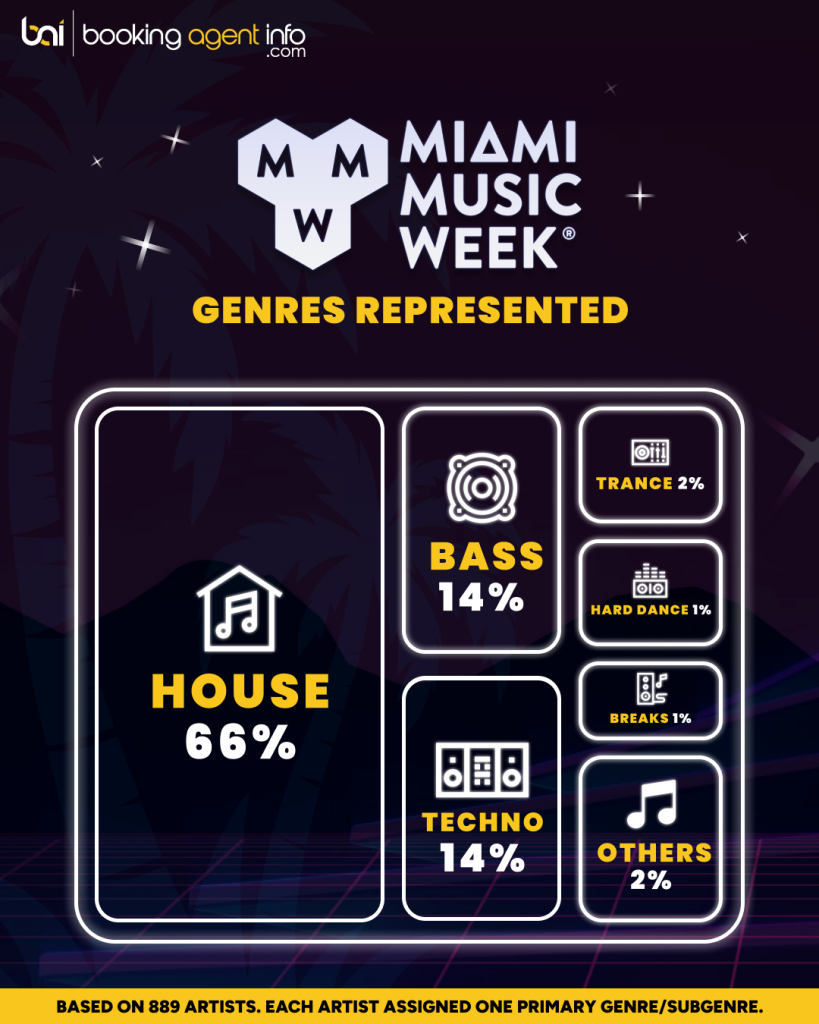
66% of all artists analyzed fell under the house umbrella, making it by far the most represented genre across Miami Music Week’s broader ecosystem.
And within that, tech house alone accounted for 33% of the total artist pool, meaning roughly 1 out of every 3 artists analyzed came from that subgenre.
That is a major concentration.
It also reinforces something that has become increasingly clear in live electronic music: while Miami Music Week continues to position itself as a broad celebration of dance culture, the market itself is heavily centered around sounds that are working most consistently at scale. In this case, that means house music, and especially tech house.
What is also notable is that house did not dominate through just one lane. Beyond tech house, the genre’s presence extended across multiple subgenres: deep house accounted for 13% of artists, while minimal/deep tech and electro house each represented 5%. Afro house came in at 3%, with melodic house and progressive house each representing 1%.
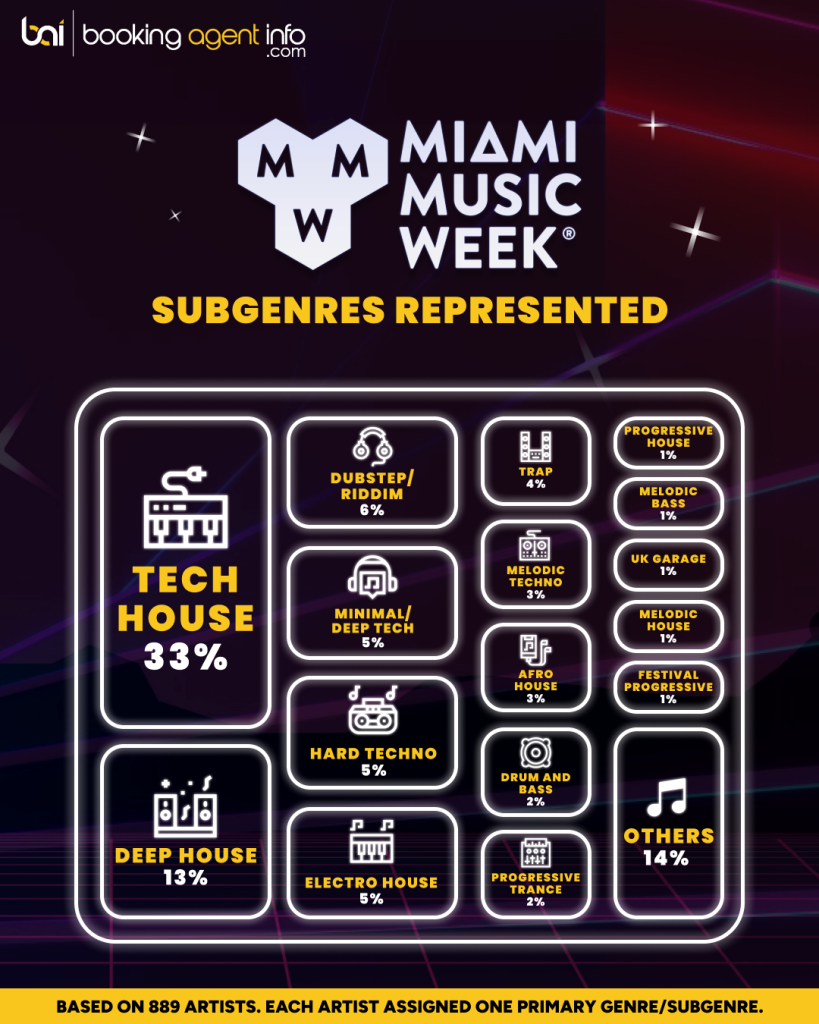
Outside of house, bass and techno each accounted for 14% of artists, tying as the next-largest genre groups in the analysis. Within bass, dubstep/riddim led at 6%, followed by trap at 4% and drum and bass at 2%. Within techno, hard techno represented 5% and melodic techno 3%.
Those are still meaningful shares, and they show that Miami Music Week remains stylistically diverse. But they also make the hierarchy more obvious: bass and techno were strong secondary forces, while house stood in a tier of its own.
Meanwhile, other genres that remain part of the dance music conversation represented much smaller portions of the total lineup. Trance accounted for 2%, while hard dance and breaks each represented 1%.